

Navigating Rates

Office real estate – medium-term headwind?

For many white-collar workers in the West, one of the enduring changes brought about by the Covid-19 pandemic was a change in workplace location. According to data from the Survey of Workplace Arrangements and Attitudes, before the pandemic fewer than 5% of US workdays were taken from home. After peaking at 60% in the early weeks of the pandemic, this remains at nearly 30%. This drastic change in working patterns is causing a profound shift in demand for office space.

Key takeaways
  • The change in working patterns caused by the pandemic has led to a significant revaluation of office real estate.
  • Given the sharp increase in financing costs, a fair question to ask is if whether commercial real estate (CRE) can create significant risk in the US financial system and specifically for banks.
  • Unlike in past real estate crises, this time the exposure of large US banks is low. Risk appears to be concentrated in smaller banks, although granular disclosure here is limited.

Cushman and Wakefield report that, by the second quarter of 2023, nearly one fifth of US office space was vacant1, a dramatic increase from the roughly 13% vacancy rate before the pandemic. The increase in vacancy rates shows no signs of slowing, and is likely to increase further. As leases come to an end, firms will make adjustments to their real estate footprint to accommodate this shift in working patterns.

The rising vacancy rate, combined with the significantly higher interest rate environment, has led to a large reduction in commercial real estate (CRE) values, particularly for office. The total value of US office CRE is estimated to be around $5tn, although some analysts believe that this value could decline by more than one third in the coming years. Unlike some previous crises, the losses this time will likely be spread widely. Disclosure around who the ultimate owners of US office real estate is patchy. While REITs and Private Equity firms are large owners of commercial real estate, most of their exposure is outside the office area. While a quarter of REIT assets were office at the turn of the millennium, by 2021 that had shrunk to around 5%. Likewise, the largest private equity firm globally, Blackstone Inc, recently reported that US office represents less than 2%1 of their real estate portfolio, down from more than 60% in 20072

Many of the assets have been picked up by pension funds, endowments and foundations, who likely own a majority of real estate. These investors typically have around 10% allocation to real estate, and some of the largest have begun to write down the value of their real estate in response to the weakening market. However, after years of strong returns from equities and alternative assets, and with limited near-term cash requirements, these value reductions are likely to be manageable for these investors. In the past, banks have had significant exposure as lenders. Banks have often been significant enablers of real estate booms – extending larger and larger loans supported by ephemeral valuations of the underlying real estate – before suffering significantly in the aftermath. The Global Financial Crisis in 2007-9 is the most prominent recent example of this. However, such an outcome is less likely this time: the largest US banks have kept exposures down, with almost all reporting that office exposure represents less than 4% of their loan books, and that these loans were more conservatively underwritten than CRE loans written before the Global Financial Crisis, with loan-to-value ratios below 60% and good debt service cover. To date, the impact on banks has been small: reported losses on office CRE loans have been minimal, although delinquency rates on loans have nearly tripled from the low levels seen in late 2022. 

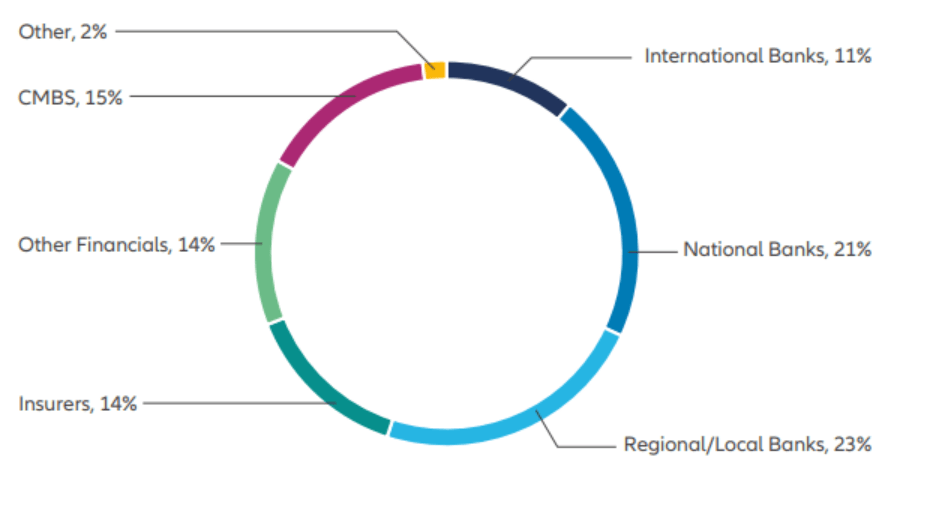
So, if not with the large banks, where does the risk lie? Within the financials industry, there are two areas at most risk from large loans to real estate. The first is at smaller banks (those with less than $100bn of assets). These smaller banks, of which there are more than 4,000 in the US3, represent around a quarter of total US banking system assets, but are estimated4 to hold more than 70% of the bank loans to office and downtown retail CRE. Many of these loans were made relatively recently and at elevated property values, as these banks sought to deploy the huge inflows of deposits seen during the extraordinary monetary and fiscal stimulus deployed in response to the pandemic. According to Moody’s, the number of US banks with CRE concentrations in excess of regulators’ 2006 CRE guidance levels has increased from 300 to 700 in the last two years (implying more than one out of every 10 US banks has CRE concentrations in excess of supervisory guidance). These smaller banks will suffer two additional challenges. First, in many cases their office loans are concentrated in a small number of markets. While nationwide office vacancy rates are close to 20%, the vacancy rate is much higher in major cities like San Francisco, New York, Chicago, and Los Angeles, as well as some regional markets. The exact location of the underlying buildings matters, and some banks will have large exposures to particularly challenged markets. Second, in many cases the loans these banks have made are too small to be of interest to non-bank lenders, preventing these banks from exiting problem loans. The challenge for investors is to assess which of the 4,000 banks have large exposure, as disclosures on this matter vary significantly by firm.

 Office CRE Lender Share
MSCI Europe consensus EPS

Source: Morgan Stanley (March 16, 2023), Real Capital Analytics

The second sector most at risk is life insurers. Real estate as an asset class is attractive to this investor type: with large amounts of long duration customer capital, real estate and loans to real estate represents a long duration, asset-backed asset class. Based on estimates from Jefferies, the largest life insurers have around one sixth of their investment assets invested in CRE. However, because of the high leverage embedded in life insurers business models, the real estate exposure approaches 200% of statutory capital. Like the large banks, the large life insurance companies have reported that they see the risk as being low, with loans  to value on office loans around the 50-60% level and with the loans well covered by rental income. These metrics will likely continue to deteriorate, but the risk to the life insurers looks low.

While losses might be large, they will be widely dispersed and are likely to be realised over many years, as the vast majority of real estate loans mature beyond 2025. Borrowers and lenders have time to resolve problem loans, which will be a key focus for many institutions in the coming few years. 

1 Q2 2023 results
2  SDC conference 2023 transcript
3 FDIC data
4 Estimate from barclays


3088974

Recent insights

Private Markets

European private credit is thriving, driven by sector diversification, digitalization, energy transition, and stable returns, offering a strong alternative to US markets.

Discover more

Navigating Rates

Deglobalisation drives new infrastructure opportunities. Allianz GI highlights investing in energy security, digital resilience, and local supply chains.

Discover more

The global economy enters 2026 bending but not breaking. We expect growth to stay on track, creating an environment that favours risk-taking. Expect a resilient yet complex year where active management will be critical.

DISCOVER NOW

Allianz Global Investors

You are leaving this website and being re-directed to the below website. This does not imply any approval or endorsement of the information by Allianz Global Investors Asia Pacific Limited contained in the redirected website nor does Allianz Global Investors Asia Pacific Limited accept any responsibility or liability in connection with this hyperlink and the information contained herein. Please keep in mind that the redirected website may contain funds and strategies not authorized for offering to the public in your jurisdiction. Besides, please also take note on the redirected website’s terms and conditions, privacy and security policies, or other legal information. By clicking “Continue”, you confirm you acknowledge the details mentioned above and would like to continue accessing the redirected website. Please click “Stay here” if you have any concerns.

Welcome to Allianz Global Investors, Asia Pacific

Select your role
  • Institutional Investor
  • The website is for use by qualified Institutional Investors (or Professional/Sophisticated/Qualified Investors as such term may apply in local jurisdictions).

    Please read this page before proceeding. By clicking to “OK” this site, the entrant has agreed that he/she has reviewed and agreed on the terms contained herein in their entirety including any legal or regulatory rubric and has consented to the collection, use and disclosure of his or her personal data as set out in the Privacy referred to below.

    The information contained in this website is made available for informational purposes only. Any form of publication, duplication, extraction, transmission and passing on of the contents of this website is impermissible and unauthorised.

    Local Restrictions

    This website or information contained or incorporated in this website has not been, and will not be submitted to, become approved/verified by, or registered with, any relevant government authorities under the local laws. This website is not intended for and should not be accessed by persons located or resident in any jurisdiction where (by reason of that person's nationality, domicile, residence or otherwise) the publication or availability of this website is prohibited or contrary to local law or regulation or would subject any AllianzGI entity to any registration or licensing requirements in such jurisdiction. It is your responsibility to be aware of, to obtain all relevant regulatory approvals, licenses, verifications and/or registrations under, and to observe all applicable laws and regulations of any relevant jurisdiction in connection with your entrant to this Website.

    This website or information contained or incorporated in this website have been prepared for informational purposes only without regard to the investment objectives, financial situation, or means of any particular person or entity. The details are not to be construed as a recommendation or an offer or invitation to trade any securities or collective investment schemes nor should any details form the basis of, or be relied upon in connection with, any contract or commitment on the part of any person to proceed with any transaction. The details are also not to be construed as soliciting/ promoting any financial products or services or a recommendation to purchase or sell any particular security or strategy or an investment advice.

    Forward-looking statements

    The views and opinions expressed in this website or information contained or incorporated in this website, which are subject to change without notice, are those of Allianz Global Investors at the time of publication. While we believe that the information is correct at the date of this material, no warranty of representation is given to this effect and no responsibility can be accepted by us to any intermediaries or end users for any action taken on the basis of this information. Some of the information contained herein including any expression of opinion or forecast has been obtained from or is based on sources believed by us to be reliable as at the date it is made, but is not guaranteed and we do not warrant nor do we accept liability as to adequacy, accuracy, reliability or completeness of such information. The information is given on the understanding that any person who acts upon it or otherwise changes his or her position in reliance thereon does so entirely at his or her own risk without liability on our part. There is no guarantee that any investment strategies and processes discussed herein will be effective under all market conditions and investors should evaluate their ability to invest for a long-term based on their individual risk profile especially during periods of downturn in the market.

    The content may contain statements that are not purely historical in nature but are forward-looking statements, which are based on certain assumptions, risks and uncertainties. Actual events may differ from the those assumed. There can be no assurance that forward-looking statements will materialised or actual market conditions and/performance results will not be materially different or worse than those presented.

    No information on this website constitutes business, financial, investment, trading, tax, legal, regulatory, accounting or any other advice. If you are unsure about the meaning of any information provided, please consult your financial or other professional adviser.

    No Liability

    Allianz Global Investors shall have no liability for any loss or damage arising in connection with this website or out of the use, inability to use or reliance on the contents by any person, including without limitation, any loss of profit or any other damage, direct or consequential, regardless of whether they arise from contractual or tort (including negligence) or whether Allianz Global Investors has foreseen such possibility, except where such exclusion or limitation contravenes the applicable law.

    You may leave this website when you access certain links on this website. Allianz Global Investors has not examined any of these websites and does not assume any responsibility for the contents of such websites nor the services, products or items offered through such websites.

    Allianz Global Investors shall have no liability for any data transmission errors such as data loss or damage or alteration of any kind, including, but not limited to, any direct, indirect or consequential damage, arising out of the use of this website.

Please indicate you have read and understood the Important Notice.