


House View

House View Q3 2026: Shock absorption​

Our view of global markets

Selectivity matters

  • The global economy is bending under successive shocks, but not breaking. Following the disruption from US tariffs, the Middle East crisis now appears to be stabilising. But oil prices remain elevated, inflations is still above target in most major economies, and the macro backdrop remains vulnerable to renewed volatility ahead of the US mid-term elections.
  • What matters for investors is not just market direction, but the range of possible outcomes. Gaps across regions, asset classes and narratives are widening: the US remains relatively resilient, while Europe and parts of Asia are more sensitive to shifts in energy supply and prices. Markets are sending conflicting signals, with bonds pointing to a more stagflationary path while equities reflect a more optimistic growth backdrop.
  • This divergence is playing out within asset classes. Elevated inflation risk and higher-for-longer rates are shifting attention towards value, income and quality, while AI-led investment supports growth and valuations in parts of the market. Correlations between equities and bonds have risen, making diversification less straightforward and reinforcing the case for a broader toolkit.
  • In this environment, beta alone is unlikely to be sufficient. Returns will depend on careful choices – across countries, sectors and instruments – and the ability to adapt.
  • The durability of any relief rally depends on sustained normalisation of energy flows through the Strait of Hormuz and a credible political settlement. Our base case remains one of resilience – but markets are pricing a reduction in risk, not its removal.

Icon

Chart of the quarter

US tech investment reaches new highs
US IT investment has exceeded its dot‑com era peak as a share of GDP, underlining how the AI cycle is strengthening rather than fading. As this investment broadens beyond a narrow group of firms, identifying the winners becomes more critical for investors – and more challenging.
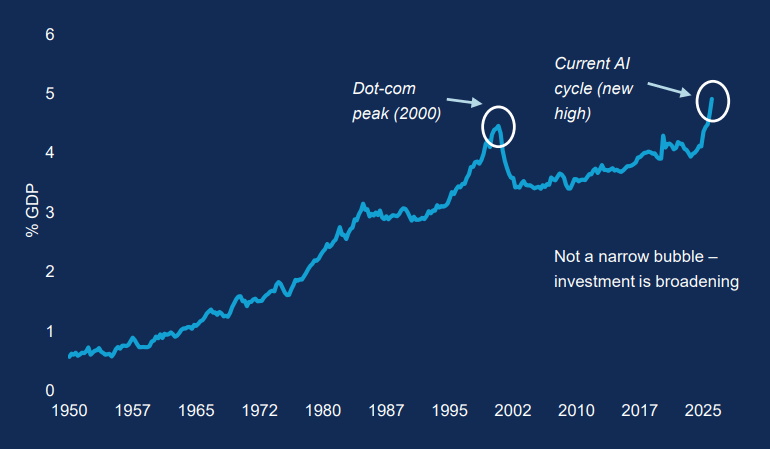
Line chart titled “US tech investment reaches new highs”. The chart shows US IT investment as a percentage of GDP rising from below 1% in 1950 to around 5% in 2025. A previous peak occurs around 2000 (dot-com), followed by a decline and steady increase. The latest data point exceeds the dot-com peak, labeled as a new high. Annotation notes investment is broadening beyond a narrow group of firms.

Source: Bloomberg and AllianzGI Economics & Strategy (data as at May 2026).

Short on time? Download the summary of our House View Q3.

Asset class convictions

Asset class convictions: equities

  • AI infrastructure is shifting from training (building models) to deployment at scale. This is broadening demand beyond graphics processing units (GPUs), pointing to diversified opportunities across semiconductors, data centre equipment, and enabling technologies.
  • Value stocks show promise, providing diversification in an AI-driven market and potentially benefiting from a different macro landscape. After a long period of “Growth” and mega-cap dominance, greater volatility and the spectre of higher-for-longer rates are driving a rotation towards fundamentals.
  • Strategic autonomy continues to grow in importance, and not just in Europe. This is evident from growing government spending on defence, energy and key infrastructure, supporting corporate activity across sectors. Beyond defence, the drive for autonomy is also evident in energy transition, digital and financial infrastructure, and manufacturing.
  • In Asia, equities are well positioned to benefit from global themes, particularly infrastructure, defence, and AI spending. China stands out given the rapid diffusion of AI across its economy. A broad ecosystem is emerging, spanning hardware, software and infrastructure, supported by strong domestic supply chains and deep STEM talent.

The statements contained herein may include statements of future expectations and other forward-looking statements that are based on management's current views and assumptions and involve known and unknown risks and uncertainties that could cause actual results, performance or events to differ materially from those expressed or implied in such statements. We assume no obligation to update any forward-looking statement.

Asset class convictions: fixed income

  • In the current environment, where the distribution of possible scenarios is unusually wide, security selection increasingly outweighs beta as a driver of return.
  • Yields have risen significantly in core rates markets, yet credit markets have not adjusted, revealing shocks are being absorbed differently across asset classes. Looking across regions and asset types, actively managing duration and focusing on higher‑quality credit can help smooth out volatility in stocks and interest rates.
  • Emerging markets (EM) offer opportunities but demand a selective approach, such as favouring oil exporters over importers. We also like long 15-year Peruvian and 10-year Brazilian local rates.
  • Early signs of a reflationary trend in China could make the renminbi one of the best diversifiers. Consider a structural long renminbi over the US dollar.
  • In credit, we prefer financials and consumer non cyclicals with a tilt towards investment grade, and we are cautious on consumer cyclicals.
  • Despite noise around private credit, overall credit fundamentals remain solid across public credit markets with low default rates. Any spread widening could be a buying opportunity.

The statements contained herein may include statements of future expectations and other forward-looking statements that are based on management's current views and assumptions and involve known and unknown risks and uncertainties that could cause actual results, performance or events to differ materially from those expressed or implied in such statements. We assume no obligation to update any forward-looking statement.

Asset class convictions: multi asset

  • We are optimistic on risk assets despite recent market volatility – and uncertainty around US data and the Fed’s interest rate path.
  • Equities are our preferred asset class, supported by resilient AI-driven earnings. We maintain balanced regional exposure, with stronger convictions especially on emerging markets. We also rebalance from US tech into Asia. In Europe, we prefer Spain and small caps.
  • In fixed income, we’re most constructive on steepeners and moderately positive on duration. We think interest rate cuts in Europe and the US will continue to support government bonds, except in Japan, where fiscal expansion and a hawkish BoJ could lead to even higher interest rates.
  • Emerging market bonds remain a core conviction for their attractive carry and resilience and complement the highquality credit in our portfolios. Underlying fundamentals in the form of strong growth and improving fiscal positions should continue to drive performance.
  • We maintain our long-term conviction on gold, underpinned by central bank demand and inflows into exchange-traded funds. We’ve upgraded our view on copper, with supply stagnating as demand grows to support infrastructure needed for the green transition and the AI boom.

The statements contained herein may include statements of future expectations and other forward-looking statements that are based on management's current views and assumptions and involve known and unknown risks and uncertainties that could cause actual results, performance or events to differ materially from those expressed or implied in such statements. We assume no obligation to update any forward-looking statement.

Private markets - mid-year outlook

  • Resilience and return potential: Private markets are well positioned to deliver attractive risk-adjusted returns, supported by higher base rates, tighter bank regulation and wider spreads, which continue to create opportunities relative to public markets.
  • Focus on fundamentals: Recent headlines have heightened scrutiny around valuations, redemptions and late-cycle risks, reinforcing a focus on fundamentals, greater transparency and more conservative structures.
  • Diversification remains essential: Allocating across strategies, vintages, geographies and primary and secondary investments helps manage uncertainty, smooth deployment and avoid concentration risks.
  • Rising importance of selectivity: Greater dispersion across assets and managers increases the need for robust underwriting, strong covenants and platforms with deep origination and workout expertise.
  • Secondaries as a core allocation: In our view, LP- and GP-led secondaries provide access to seasoned portfolios, enhanced liquidity and potentially attractive entry points.
  • Infrastructure driven by secular themes: Geopolitical volatility strengthens the case for energy security and independence, while digitalisation and decarbonisation drive demand, particularly in areas such as data centres, grids and storage.
  • Private credit remains compelling: Its growing role in mid-market financing, alongside rising demand for infrastructure credit, direct lending across Europe and Asia, and low-correlation impact strategies, underpins continued growth.
  • Private equity gradually recovering: Improving exit activity may support a recovery, while liquidity constraints continue to drive demand for secondaries.

Our latest thinking on macroeconomics and markets, plus high-conviction ideas from our asset class CIOs.

Our full House View includes comprehensive analysis and proprietary data on investment markets.
Download PDF
This is a summary of our House View Q3 2026
Download PDF

This document reflects the views of Allianz Global Investors’ investment leadership going into Q3 2026. Past performance does not predict future returns. The statements contained herein may include statements of future expectations and other forward-looking statements that are based on management’s current views and assumptions and involve known and unknown risks and uncertainties that could cause actual results, performance or events to differ materially from those expressed or implied in such statements. We assume no obligation to update any forward-looking statement.

House View archives

Global markets enter the second quarter navigating a more complex backdrop than many expected at the start of the year. Growth slows yet stays resilient; sticky inflation could delay rate cuts and keep policy tight. We prioritise selective duration, quality carry, AI linked equities and remain cautious on the US dollar.

Discover more

The global economy enters 2026 bending but not breaking. We expect growth to stay on track, creating an environment that favours risk-taking. Expect a resilient yet complex year where active management will be critical.

Discover more

Markets are coming to terms with a new reality that requires caution. But this evolving backdrop may open the door to opportunities for actively positioned investors.

Discover more

Allianz Global Investors

You are leaving this website and being re-directed to the below website. This does not imply any approval or endorsement of the information by Allianz Global Investors Asia Pacific Limited contained in the redirected website nor does Allianz Global Investors Asia Pacific Limited accept any responsibility or liability in connection with this hyperlink and the information contained herein. Please keep in mind that the redirected website may contain funds and strategies not authorized for offering to the public in your jurisdiction. Besides, please also take note on the redirected website’s terms and conditions, privacy and security policies, or other legal information. By clicking “Continue”, you confirm you acknowledge the details mentioned above and would like to continue accessing the redirected website. Please click “Stay here” if you have any concerns.