


House View

House View Q2 2026: Holding the line

Our view of global markets

Test of resilience

  • Global markets enter the second quarter navigating a more complex backdrop than many expected at the start of the year. The conflict in the Middle East adds a fresh layer of geopolitical uncertainty that could prove a significant test for the global economy. Outcomes hinge on how long warfare persists and the scale of energy-market disruption. While effects are still unfolding, the conflict has already heightened risks to growth and inflation, particularly for energy-dependent economies in Europe and Asia.
  • Even so, our core view remains one of “bending but not breaking”. The global economy still shows resilience, supported by strong investment in artificial intelligence – now a key pillar of growth, especially in the US. But higher energy costs may keep inflation above central bank targets in several major economies, limiting the scope for policy easing. We now expect the US Federal Reserve’s next cut in the second half of 2026, with the Bank of England likely to proceed cautiously. Higher energy prices are also a factor behind our downgrade to euro zone growth.
  • We see oil prices in the USD 90-110 range as manageable – the greater risk comes if levels stay elevated for an extended period, raising the threat of a more stagflationary mix of higher inflation and weaker growth and challenging the consensus “Goldilocks” narrative. This backdrop favours resilience‑building: diversified portfolios and a focus on long‑term goals can help investors look through near‑term volatility.
  • Against this backdrop, our asset class convictions emphasise selective duration, quality carry and equity themes aligned with strategic autonomy – including defence – and the AI enablers driving the next phase of technological transformation. We remain structurally cautious on the US dollar, despite short-term gains as a safe haven.

Icon

Chart of the quarter

What is the economic impact of higher oil prices?
Crude oil underpins countless products and supply chains. The chart shows the range of estimates of how every supply‑driven 10% increase in oil prices would affect GDP and inflation, with the dots representing the average estimated impact.
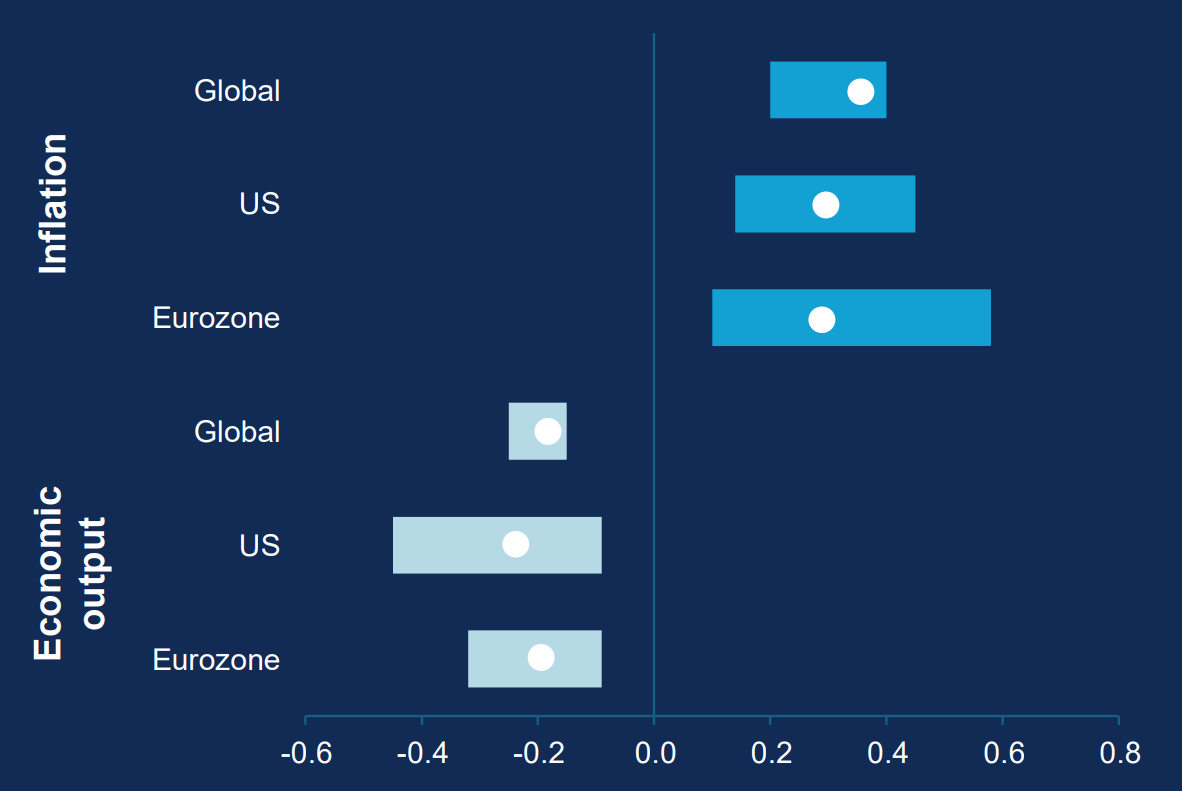
Crude oil underpins countless products and supply chains. The chart shows the range of estimates of how every supply‑driven 10% increase in oil prices would affect GDP and inflation, with the dots representing the average estimated impact.

Source: AllianzGI Economics & Strategy. Note: Sensitivities based on 68 individual estimates by central banks (US Federal Reserve, European Central Bank, Bank of Canada, Oesterreichische Nationalbank, Banco de España), international organisations (IMF, OECD, World Bank, World Economic Forum), and academic and financial institutions (JPMorgan, Goldman Sachs, Morgan Stanley, BNP Paribas, Société Générale, Deutsche Bank, UBS, HSBC). Estimates exclude second-round effects from higher natural gas prices, particularly in the euro zone, as well as potential non-linearities.


Short on time? Download the summary of our House View Q2.

Asset class convictions

Asset class convictions: equities

  • Europe’s push for strategic autonomy continues to be reinforced by expansive fiscal policy that is mobilising private capital. The theme is also becoming more prominent globally as countries seek to reduce dependence on volatile fossil fuel prices or increase independence in defence and other areas.
  • Recent developments in the Middle East have highlighted both the urgency and limits of existing energy stockpiles. Energy dependence and vulnerable infrastructure have also come into sharper focus. This could boost demand in related sectors, even as elevated oil prices weigh on global growth if they remain high for a prolonged period.
  • Despite rising geopolitical tensions, AI will remain a key theme in global equity markets. China is entering the first wave of broad AI diffusion, supported by deep supply chains and innovation across hardware, models and robotics. Analogue semiconductors are beginning an early-cycle recovery, driven by improving end markets, tighter capacity discipline and strong earnings revisions.
  • Electrification and AI-driven power demand are underpinning investment in generation, grids and related equipment. Data centre growth means power and grid assets will likely be key bottleneck beneficiaries. These growth areas will also continue to drive demand for critical minerals and related industrial commodities.

The statements contained herein may include statements of future expectations and other forward-looking statements that are based on management's current views and assumptions and involve known and unknown risks and uncertainties that could cause actual results, performance or events to differ materially from those expressed or implied in such statements. We assume no obligation to update any forward-looking statement.

Asset class convictions: fixed income

  • Volatility has re-emerged as markets reassess prior complacency and certainty. The market is no longer rewarding indiscriminate risk-taking; it is rewarding selectivity.
  • For fixed income, oil-driven inflation risks compete with risk aversion flows. Duration performance will hinge on how persistent higher energy prices prove to be, while credit risk is asymmetric, with certain countries in emerging and frontier markets most exposed.
  • This environment favours quality carry, balance-sheet strength and active duration management over broad beta exposure.
  • Re-emerging inflation risks present a more challenging backdrop for headline duration.
  • Despite elevated equity volatility, credit markets continue to trade in a historically tight and orderly range. We prefer to be selective and keep powder dry as defaults re-enter the headlines; security selection needs to do the heavy lifting.
  • Emerging market debt offers diversification, but also resilience. We favour a fundamentals-driven approach, with a focus on country-specific improvement stories.
  • Asian credit may offer a sweet spot, with local markets trading with lower volatility than broader emerging markets, reinforcing Asia’s role as a supportive allocation within global fixed income portfolios.

The statements contained herein may include statements of future expectations and other forward-looking statements that are based on management's current views and assumptions and involve known and unknown risks and uncertainties that could cause actual results, performance or events to differ materially from those expressed or implied in such statements. We assume no obligation to update any forward-looking statement.

Asset class convictions: multi asset

  • We remain constructive on global equities over the long term, but are more cautious in the short term as the risk premium from the Middle East conflict tempers our conviction.
  • Within equities our preference is for emerging markets, Japan and the euro zone; we are more cautious on the US.
  • In fixed income, the Iran conflict has increased the duration premium in bonds by raising the risk of higher inflation and fewer central bank rate cuts.
  • But we are a notch more optimistic on UK Gilts, euro zone sovereigns and emerging market hard currency bonds, while remaining nimble given geopolitical and inflation risks.
  • We hold an overall positive view on commodities, with geopolitical friction keeping energy prices elevated and undersupply supporting metals.
  • Gold remains a core long-term conviction; we stay overweight on copper as supply lags robust demand.
  • In FX, our expectation for a lower US dollar has been tempered by conflict-driven dollar strength and we remain tactically flexible.
  • Overall, we have increased our “dry powder” to capture entry points created by volatility in the coming months.

The statements contained herein may include statements of future expectations and other forward-looking statements that are based on management's current views and assumptions and involve known and unknown risks and uncertainties that could cause actual results, performance or events to differ materially from those expressed or implied in such statements. We assume no obligation to update any forward-looking statement.

Our latest thinking on macroeconomics and markets, plus high-conviction ideas from our asset class CIOs.

Our full House View includes comprehensive analysis and proprietary data on investment markets.
This is a summary of our House View Q2 2026

This document reflects the views of Allianz Global Investor’s investment leadership going into Q2 2026. Past performance does not predict future returns. The statements contained herein may include statements of future expectations and other forward-looking statements that are based on management’s current views and assumptions and involve known and unknown risks and uncertainties that could cause actual results, performance or events to differ materially from those expressed or implied in such statements. We assume no obligation to update any forward-looking statement.

W5350867

House View archives

The global economy enters 2026 bending but not breaking. We expect growth to stay on track, creating an environment that favours risk-taking. Expect a resilient yet complex year where active management will be critical.

Discover more

Markets are coming to terms with a new reality that requires caution. But this evolving backdrop may open the door to opportunities for actively positioned investors.

Discover more

Tariffs and geopolitics may have unsettled investors – but rebounding financial markets might prompt a change of heart. Our House View guides investors as opportunities emerge.

Discover more

Allianz Global Investors

You are leaving this website and being re-directed to the below website. This does not imply any approval or endorsement of the information by Allianz Global Investors Asia Pacific Limited contained in the redirected website nor does Allianz Global Investors Asia Pacific Limited accept any responsibility or liability in connection with this hyperlink and the information contained herein. Please keep in mind that the redirected website may contain funds and strategies not authorized for offering to the public in your jurisdiction. Besides, please also take note on the redirected website’s terms and conditions, privacy and security policies, or other legal information. By clicking “Continue”, you confirm you acknowledge the details mentioned above and would like to continue accessing the redirected website. Please click “Stay here” if you have any concerns.