


Interpreting China

How climate risk integration is disrupting the Chinese investment landscape

Key takeaways
  • Attitudes towards the climate risks faced by Chinese corporates are changing.
  • This is part of a broader shift in perspectives among Chinese consumers, business, and investors.
  • An active investment approach – born of both deep local knowledge and an ongoing dialogue with relevant Chinese companies – is essential to translate these macro trends into favourable stock picking.

That investors should care about climate risk seems like a statement of the obvious; acceptance of the potential dangers of climate change and the need to accelerate the green transition are now widely accepted among policy makers, financial market participants, and beyond. Indeed, assessing and quantifying the impact of climate risk on individual investments and portfolios is now standard practice across much of the industry, with climate-related reporting and disclosures becoming mandatory in some jurisdictions. Yet, amid an increasing global focus on these issues, many investors in Chinese equity markets have, so far, largely ignored the significance of climate risk, while others have certainly been put off by a perceived unwillingness among Chinese corporates to address these issues. However, this is certainly set to change as the impacts of both global and domestic Chinese regulation, as well as consumer preferences and the possible impact of extreme adverse weather events, are increasingly factored into analyses of the future growth potential of Chinese companies. These changes will lead to an evolution of the Chinese equity landscape, as well as bringing in potential investors who were previously sceptical of attitudes towards these risks in the Chinese market.

Chart 1: Global equity return sensitivity to increase in the climate risk indices
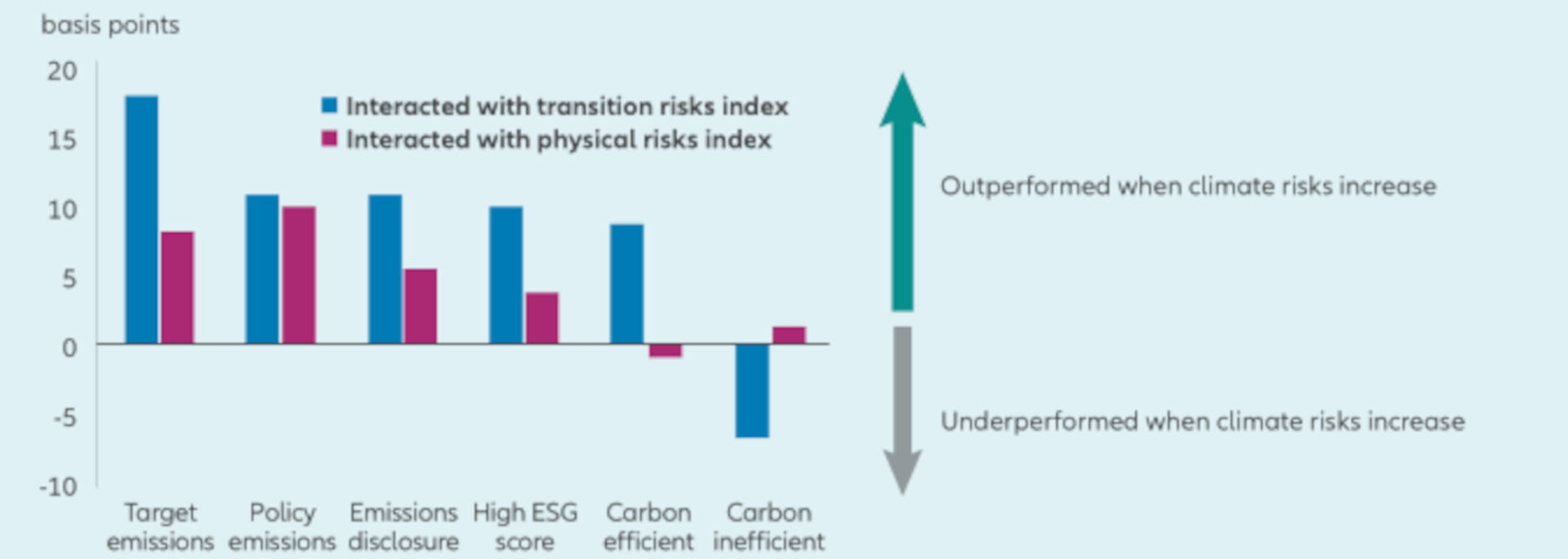

Source: HKMA, Research Memorandum 08/2021, ARE INVESTORS SENSITIVE TO CLIMATE-RELATED TRANSITION AND PHYSICAL RISKS? EVIDENCE FROM GLOBAL STOCK MARKETS. This charts shows global equity’s return sensitivity to changes in climate risk indices. Each pair of blue and purple bars represents equity return sensitivity to increases in the transition and physical risks indices, respectively, for firms in the green/brown categories specified along the x-axis.

Defining climate risk

Climate risk can be broken down into two areas: physical risks and transition risks. Physical risks encompass the potential for damage to assets and productive capacity caused by acute climate-related events such as wildfires and floods, as well as the impact of chronic changes such as temperature, water shortages, and sea level rises. Indeed, issues around water present unique challenges for Chinese corporates in several ways. In terms of sea level rises and extreme weather, China’s population and its economic output is focused on densely populated low-elevation and coastal cities, accounting for around 33% of its GDP.1 Furthermore, problems with water scarcity and pollution have long been potential causes of political and economic instability in parts of China, and resolving these issues will be key to China’s ambitions to be a global biodiversity champion.

Whether recent extreme weather or weather-induced events seen across the globe – such as wildfires in the US and Australia, and floods in Europe – are linked to climate change or not, climate-related physical risks certainly represent the greatest potential financial hazard for corporates in the short term, and something that perhaps requires particular attention in China. Furthermore, these types of risks can be hard to assess and quantify, and often depend heavily on corporate disclosure of relevant data.

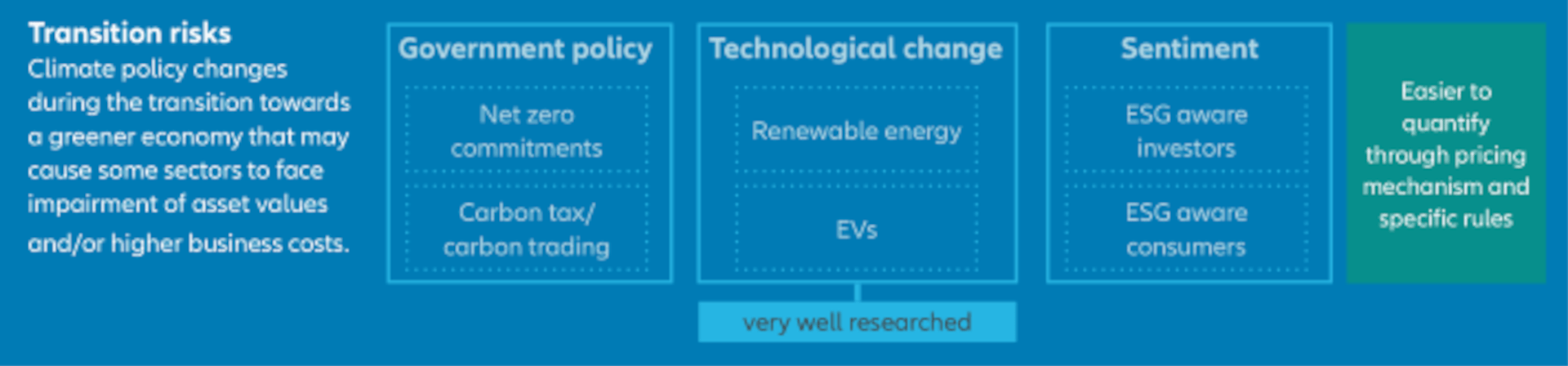
Transition risks, on the other hand, largely stem from the impact of government policy, but also include the effects of both technological development and changing public sentiment on company performance. These types of risks are, in many cases, easier to quantify through rules and mechanisms that allow us to assess potential impacts on asset value and business costs. This relative ease in identifying and quantifying transition risks means that it is these risks that are now receiving the greatest attention are set to be thoroughly integrated into analysts’ and investors’ assessments of Chinese equities.

Factoring in transition risk

For transition risks – both with respect to Chinese companies and beyond – decarbonization is the main theme driving changing regulations, technological developments, and public sentiment towards companies and brands. Looking domestically, China’s “3060” decarbonization plan – the goal of hitting peak carbon dioxide emissions by 2030 and carbon neutrality by 2060 – encompasses several elements that will impact companies in different sectors to varying degrees depending on their absolute carbon emissions and their intensity of carbon use. For instance, the Chinese national emission trading scheme (ETS) began operating 2021 covering over 2,000 companies in the power sector, and its scope is set to expand to cover further industries. Aside from its expansion to cover more sectors, the aims for the ETS in the coming years include specifying long term carbon reduction targets, building out the necessary legal framework, enhancing corporate carbon data quality and disclosure, and potentially increasing the carbon price. These are all factors that present varying risks – and potential opportunities – to Chinese companies, and the growing impact of the ETS is something that all investors in Chinese equities must now consider.

Climate risks: physical risks and transition risks

Physical risks Physical risks

Of course, for a country as integrated into global supply chains as China, regulation is not just a domestic issue – a range of other national and transnational legislation focusing on decarbonization and transition will also be hugely impactful on Chinese companies. A good example of the impact of legislation completely outside the purview of Chinese regulators comes with the EU’s Carbon Border Adjustment Mechanism (CBAM). The mechanism is essentially an additional tariff on carbon intensive products imported into the EU and is designed to stem “carbon leakage” from European Union into countries without a carbon price. The legislation will come into force in 2026, with the level of tax ramping up to reach its full value in 2035. While the short-term impact on Chinese corporates is likely to be limited to steel and aluminum manufacturers, this impact is likely to increase if and when the scope of the CBAM is broadened to include non-direct emissions, other carbon intensive industries, and end products that contain carbon intensive materials. Indeed, the CBAM will likely trigger an acceleration of China’s domestic ETS to assist local companies in maintaining their international competitiveness.

A final element of transition risk that must be accounted for is the changing preferences of both investors and end consumers. These changing preferences are leading to a greater proportion of overall investment capital dedicated to ESG investing, and fund outflows from the most carbon intensive areas. However, we are already seeing the most proactive and efficient players – with comprehensive climate disclosures and decarbonization targets – attracting greater flow from investors, and Chinese companies will be no exception to this.

MSCI China Index Constituents - Has the company set targets or objectives to be achieved on emission reduction?
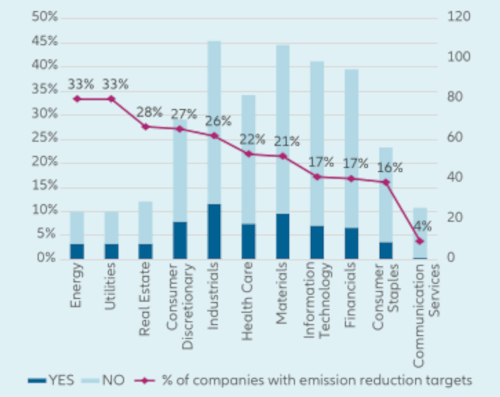

Source: Allianz Global Investors

Changing attitudes

The changes we are now seeing – and that will accelerate in the coming months and years – are indicative of fundamental changes to attitudes towards climate risk in China, and not just in the disclosure and reporting practices of listed companies. This is not just about risk management, but rather about how changing Chinese attitudes are disrupting established ways of doing business in the country. In this respect, we are seeing Chinese consumer expectations evolving in terms of attitudes towards climate and the environment, something reflected in, for example, the drive to clean rivers and achieve better air quality in major cities, as well as in the success of those transition-related industries – such as EVs and solar power – where China is showing leadership.

In this respect, the growing awareness and integration of climate risk by Chinese corporates, financials, and investors is part of a broader sea change that will alter both how business is conducted in China, as well as the attitudes of external partners and investors – potentially opening up investment in domestic Chinese companies to a broader range of investors, especially those that have perhaps previously harboured misgivings around local companies’ commitments to addressing climate change.

Opportunities for investors

While the greater integration of climate risks into assessments of Chinese companies is likely to lead to headwinds for some sectors, in the short term at least, the changing landscape will also present significant opportunities for those taking a nuanced and differentiated approach to investing in Chinese equities.

An active approach to investing in China – that involves a discernment born of both deep local knowledge and an ongoing dialogue with relevant Chinese companies – is thus essential in order to translate the types of macro trends discussed above into identifying an opportunity set and implementing favourable stock picking.


The document is for use by qualified Institutional Investors (or Professional/Sophisticated/Qualified Investors as such term may apply in local jurisdictions)..

This document or information contained or incorporated in this document have been prepared for informational purposes only without regard to the investment objectives, financial situation, or means of any particular person or entity. The details are not to be construed as a recommendation or an offer or invitation to trade any securities or collective investment schemes nor should any details form the basis of, or be relied upon in connection with, any contract or commitment on the part of any person to proceed with any transaction.

Any form of publication, duplication, extraction, transmission and passing on of the contents of this document is impermissible and unauthorised. No account has been taken of any person’s investment objectives, financial situation or particular needs when preparing this content of this document. The content of this document does not constitute an offer to buy or sell, or a solicitation or incitement of offer to buy or sell, any particular security, strategy, investment product or services nor does this constitute investment advice or recommendation.

The views and opinions expressed in this document or information contained or incorporated in this document, which are subject to change without notice, are those of Allianz Global Investors at the time of publication. While we believe that the information is correct at the date of this material, no warranty of representation is given to this effect and no responsibility can be accepted by us to any intermediaries or end users for any action taken on the basis of this information. Some of the information contained herein including any expression of opinion or forecast has been obtained from or is based on sources believed by us to be reliable as at the date it is made, but is not guaranteed and we do not warrant nor do we accept liability as to adequacy, accuracy, reliability or completeness of such information. The information is given on the understanding that any person who acts upon it or otherwise changes his or her position in reliance thereon does so entirely at his or her own risk without liability on our part. There is no guarantee that any investment strategies and processes discussed herein will be effective under all market conditions and investors should evaluate their ability to invest for a long-term based on their individual risk profile especially during periods of downturn in the market.

Investment involves risks, in particular, risks associated with investment in emerging and less developed markets. Any past performance, prediction, projection or forecast is not indicative of future performance. Investors should not make any assumptions on the future on the basis of performance information in this document. The value of an investment and the income from it can fall as well as rise as a result of market and currency fluctuations and you may not get back the amount originally invested.

Investing in fixed income instruments (if applicable) may expose investors to various risks, including but not limited to creditworthiness, interest rate, liquidity and restricted flexibility risks. Changes to the economic environment and market conditions may affect these risks, resulting in an adverse effect to the value of the investment. During periods of rising nominal interest rates, the values of fixed income instruments (including short positions with respect to fixed income instruments) are generally expected to decline. Conversely, during periods of declining interest rates, the values are generally expected to rise. Liquidity risk may possibly delay or prevent account withdrawals or redemptions.

AdMaster (W): 2820563

Recent insights

Embracing Disruption

Artificial Intelligence (AI) has recently become the defining theme of global markets. From powering breakthroughs in natural language processing to enabling autonomous systems, AI is reshaping industries at an unprecedented pace. However, as valuations soar and capex surges, concerns about an “AI bubble” dominate many investor conversations. So are we witnessing another dot-com moment?

Discover more

Embracing Disruption

Capital expenditure from the world’s largest technology companies suggests they remain utterly convinced that artificial intelligence leadership is the prize of a lifetime, a once-in-a-century opportunity that will define the next generation of corporate dominance.

Discover more

Navigating Rates

Floating rate notes can help investors stay ahead of interest rate swings – offering capital stability and income opportunities when markets shift.

Discover more

Allianz Global Investors

You are leaving this website and being re-directed to the below website. This does not imply any approval or endorsement of the information by Allianz Global Investors Asia Pacific Limited contained in the redirected website nor does Allianz Global Investors Asia Pacific Limited accept any responsibility or liability in connection with this hyperlink and the information contained herein. Please keep in mind that the redirected website may contain funds and strategies not authorized for offering to the public in your jurisdiction. Besides, please also take note on the redirected website’s terms and conditions, privacy and security policies, or other legal information. By clicking “Continue”, you confirm you acknowledge the details mentioned above and would like to continue accessing the redirected website. Please click “Stay here” if you have any concerns.

Welcome to Allianz Global Investors, Asia Pacific

Select your role
  • Institutional Investor
  • The website is for use by qualified Institutional Investors (or Professional/Sophisticated/Qualified Investors as such term may apply in local jurisdictions).

    Please read this page before proceeding. By clicking to “OK” this site, the entrant has agreed that he/she has reviewed and agreed on the terms contained herein in their entirety including any legal or regulatory rubric and has consented to the collection, use and disclosure of his or her personal data as set out in the Privacy referred to below.

    The information contained in this website is made available for informational purposes only. Any form of publication, duplication, extraction, transmission and passing on of the contents of this website is impermissible and unauthorised.

    Local Restrictions

    This website or information contained or incorporated in this website has not been, and will not be submitted to, become approved/verified by, or registered with, any relevant government authorities under the local laws. This website is not intended for and should not be accessed by persons located or resident in any jurisdiction where (by reason of that person's nationality, domicile, residence or otherwise) the publication or availability of this website is prohibited or contrary to local law or regulation or would subject any AllianzGI entity to any registration or licensing requirements in such jurisdiction. It is your responsibility to be aware of, to obtain all relevant regulatory approvals, licenses, verifications and/or registrations under, and to observe all applicable laws and regulations of any relevant jurisdiction in connection with your entrant to this Website.

    This website or information contained or incorporated in this website have been prepared for informational purposes only without regard to the investment objectives, financial situation, or means of any particular person or entity. The details are not to be construed as a recommendation or an offer or invitation to trade any securities or collective investment schemes nor should any details form the basis of, or be relied upon in connection with, any contract or commitment on the part of any person to proceed with any transaction. The details are also not to be construed as soliciting/ promoting any financial products or services or a recommendation to purchase or sell any particular security or strategy or an investment advice.

    Forward-looking statements

    The views and opinions expressed in this website or information contained or incorporated in this website, which are subject to change without notice, are those of Allianz Global Investors at the time of publication. While we believe that the information is correct at the date of this material, no warranty of representation is given to this effect and no responsibility can be accepted by us to any intermediaries or end users for any action taken on the basis of this information. Some of the information contained herein including any expression of opinion or forecast has been obtained from or is based on sources believed by us to be reliable as at the date it is made, but is not guaranteed and we do not warrant nor do we accept liability as to adequacy, accuracy, reliability or completeness of such information. The information is given on the understanding that any person who acts upon it or otherwise changes his or her position in reliance thereon does so entirely at his or her own risk without liability on our part. There is no guarantee that any investment strategies and processes discussed herein will be effective under all market conditions and investors should evaluate their ability to invest for a long-term based on their individual risk profile especially during periods of downturn in the market.

    The content may contain statements that are not purely historical in nature but are forward-looking statements, which are based on certain assumptions, risks and uncertainties. Actual events may differ from the those assumed. There can be no assurance that forward-looking statements will materialised or actual market conditions and/performance results will not be materially different or worse than those presented.

    No information on this website constitutes business, financial, investment, trading, tax, legal, regulatory, accounting or any other advice. If you are unsure about the meaning of any information provided, please consult your financial or other professional adviser.

    No Liability

    Allianz Global Investors shall have no liability for any loss or damage arising in connection with this website or out of the use, inability to use or reliance on the contents by any person, including without limitation, any loss of profit or any other damage, direct or consequential, regardless of whether they arise from contractual or tort (including negligence) or whether Allianz Global Investors has foreseen such possibility, except where such exclusion or limitation contravenes the applicable law.

    You may leave this website when you access certain links on this website. Allianz Global Investors has not examined any of these websites and does not assume any responsibility for the contents of such websites nor the services, products or items offered through such websites.

    Allianz Global Investors shall have no liability for any data transmission errors such as data loss or damage or alteration of any kind, including, but not limited to, any direct, indirect or consequential damage, arising out of the use of this website.

Please indicate you have read and understood the Important Notice.